ICSE Class 10 Force, Turning Effects of Force, and Uniform Circular Motion — Mock Test (2027)
Free online mock test for Force, Turning Effects of Force, and Uniform Circular Motion (ICSE Class 10 Physics) — 20 competency-based questions based on the latest CISCE 2027 syllabus, with instant marking. Try the samples below, then take the full test free.
What to expect: This mock test covers key concepts from the Force, Turning Effects of Force, and Uniform Circular Motion chapter — including application-based and competency-focused questions aligned with how ICSE actually sets the paper.
Tip: Attempt without notes first to identify gaps, then review explanations for any wrong answers. Retake after a few days for best retention.
Sample questions
-
1.What is the primary role of the position of the centre of gravity (CG) in the following scenarios? 1. Loading a ship 2. Sitting/standing on the upper deck of a bus
- A.1. Raises CG to increase stability; 2. Lowers CG to reduce stability
- B.1. Lowers CG to increase stability; 2. Standing raises CG, reducing stability; sitting lowers CG, increasing stability
- C.1. CG position has no effect on stability; 2. Sitting or standing does not alter stability
- D.1. CG must be at the top for stability; 2. Standing lowers CG, increasing stability
-
2.A metre rule is balanced at its centre. A weight of 2 N is hung at the 20 cm mark. Where should a weight of 4 N be hung to balance the metre rule?
-
3.Which force is required to keep an object moving in a circular path, and what is its direction?
- A.Centrifugal force, acting radially outward from the centre.
- B.Centripetal force, acting radially inward towards the centre.
- C.Gravitational force, acting downward toward the Earth.
- D.Frictional force, acting tangent to the circular path.
-
4.Which experimental setup verifies the principle of moments using a metre scale, spring balances, and slotted weights?

- A.Adjust positions until the sum of anticlockwise moments equals the sum of clockwise moments.
- B.Ensure the metre scale is perfectly horizontal without any weights.
- C.Measure the total weight of the scale and compare it to the spring balance readings.
- D.Hang all weights on one side and adjust the spring balances until equilibrium is reached.
-
5.A uniform metre scale balances horizontally on a knife-edge placed at the 55 cm mark when a mass of 25 g is suspended from one end.
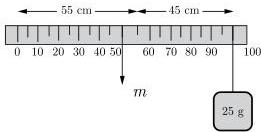 What is the mass of the scale?
- A.225 g
- B.25 g
- C.100 g
- D.50 g
Ready? Take the full 20-question test free — instant marking, no sign-up needed.
▶ Start free mock test