ICSE Class 10 Circles (Tangent and Cyclic Properties) — Mock Test (2027)
Free online mock test for Circles (Tangent and Cyclic Properties) (ICSE Class 10 Mathematics) — 20 competency-based questions based on the latest CISCE 2027 syllabus, with instant marking. Try the samples below, then take the full test free.
What to expect: This mock test covers key concepts from the Circles (Tangent and Cyclic Properties) chapter — including application-based and competency-focused questions aligned with how ICSE actually sets the paper.
Tip: Attempt without notes first to identify gaps, then review explanations for any wrong answers. Retake after a few days for best retention.
Sample questions
-
1.In the given diagram, a point P is 17 cm away from the centre O of the circle, and the length of the tangent AP drawn from P to the circle is 15 cm. Which labelled segment represents the radius of the circle?
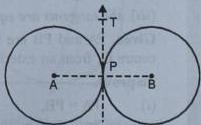
- A.OP
- B.AP
- C.OA
- D.PA
-
2.In the given figure, O is the centre of a circle. PT are tangents to the circle from an external point P. If ∠TPQ = 70°, what is the measure of ∠TRQ?
- A.40°
- B.55°
- C.70°
- D.110°
-
3.In the given figure, ΔABC is an isosceles triangle inscribed in a circle with centre O, where AB = AC. Which labeled angle or property in the diagram directly confirms that AP bisects ∠BPC?
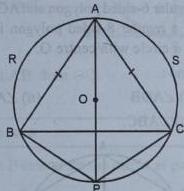
- A.∠AOB = ∠AOC because equal chords subtend equal angles at the centre
- B.∠BAC = ∠BPC because both are subtended by the same chord BC
- C.∠APB = ∠APC because AP is perpendicular to BC
- D.∠AOB = 2∠APC because the angle at the circumference is half the angle at the centre
-
4.In the given figure sides $BC$, $CA$ and $AB$ of $\Delta ABC$ touch a circle at point $D$, $E$ and $F$ respectively. If $BD = 4\mathrm{cm}$, $DC = 3\mathrm{cm}$ and $CA = 8\mathrm{cm}$, then the length of side $AB$ is
- a.$12\mathrm{cm}$
- b.$11\mathrm{cm}$
- c.$10\mathrm{cm}$
- d.$9\mathrm{cm}$
-
5.In the figure, AB is the common chord of the two circles. If AC and AD are diameters, which of the following correctly explains why points D, B, and C lie on a straight line?
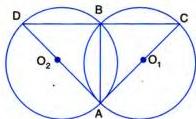
- A.∠ABD and ∠ABC are both 90° because they are angles in a semicircle, making ∠DBC = 180°.
- B.Points D, B, and C lie on the same circle, so they must be collinear.
- C.AB is the common chord, so D and C must be equidistant from B, forming a straight line.
- D.∠DBC is 90° because AC and AD are diameters, forcing D, B, and C to align.
Ready? Take the full 20-question test free — instant marking, no sign-up needed.
▶ Start free mock test