ICSE Class 10 Force, Turning Effects of Force, and Uniform Circular Motion — Mock Test (2027)
Free online mock test for Force, Turning Effects of Force, and Uniform Circular Motion (ICSE Class 10 Physics) — 20 competency-based questions based on the latest CISCE 2027 syllabus, with instant marking. Try the samples below, then take the full test free.
What to expect: This mock test covers key concepts from the Force, Turning Effects of Force, and Uniform Circular Motion chapter — including application-based and competency-focused questions aligned with how ICSE actually sets the paper.
Tip: Attempt without notes first to identify gaps, then review explanations for any wrong answers. Retake after a few days for best retention.
Sample questions
-
1.A uniform metre scale of mass 60 g, carries masses of 20 g, 30 g and 80 g from points 10 cm, 20 cm and 90 cm marks respectively. Where must the knife edge be placed to balance the scale?
-
2.Why does a rope walker hold a long pole in their hands?
- A.To adjust their centre of gravity and maintain balance on the rope.
- B.To increase their weight and improve stability.
- C.To distract the audience and enhance performance.
- D.To reduce air resistance while walking on the rope.
-
3.Fig. 1.32 shows a uniform metre rule placed on a fulcrum at its mid-point O and having a weight $40\mathrm{gf}$ at the $10\mathrm{cm}$ mark and a weight of $20\mathrm{gf}$ at the $90\mathrm{cm}$ mark. (i) Is the metre rule in equilibrium? If not, how will the rule turn? (ii) How can the rule be brought in equilibrium by using an additional weight of 40 gf?

-
4.Define the centre of gravity (C.G.) of a body. Which of the following statements correctly describes it?
- A.The point where the body balances perfectly, regardless of its orientation.
- B.The geometric center of the body, calculated as the average of all particle positions.
- C.The point where the body's mass is concentrated, but only in a uniform gravitational field.
- D.The point where the sum of all forces acting on the body equals zero.
-
5.Given the figure shows a heavy roller with axle at O to be pulled onto pavement XY, in which direction should the minimum possible force be applied?
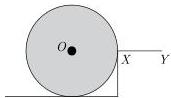
- A.Parallel to the pavement XY.
- B.Perpendicular to the radius at the point of contact.
- C.Along the line joining O and the point of contact.
- D.At a 45-degree angle to the pavement.
Ready? Take the full 20-question test free — instant marking, no sign-up needed.
▶ Start free mock test